I've decided I am not particularly good with the old blogging thing. I remembered my blog after rather a while today and decided I had to post something just so that it didn't look as if I have died!
Actually I am not sure if I like blogs because they do not seem to have too much interaction with other people. About the only useful thing is being able to post slightly longer essays so that if (on the occasion!) I happen to be discussing something with someone on a forum I can point them to a more thought through version of my thoughts. Thus said I have just started a new blog that I aim to use for recording work projects - checkout http://dockingtoolbox.blogspot.com/
Monday, 28 July 2008


Monday, 17 September 2007
Dawkins and Collins on the Colbert Report
Both Francis Collins, head of the genome project and author of "The Language of God - a scientist presents evidence for belief" and Richard Dawkins (who has been quite critical of Collins) have featured on the satirical American program "The Colbert Report". Stephen Colbert adopts the persona of an extremely conservative, Christian interviewer with rather amusing results. I'll let others judge which of the two has the better sense of humour!
You can see Collins' interview on the Comedy Central website once you've got past the adverts, and the Dawkins interview from RichardDawkins.net:
Collins on the Colbert Report
Dawkins on the Colbert Report
You can see Collins' interview on the Comedy Central website once you've got past the adverts, and the Dawkins interview from RichardDawkins.net:
Collins on the Colbert Report
Dawkins on the Colbert Report
Dawkins and cake
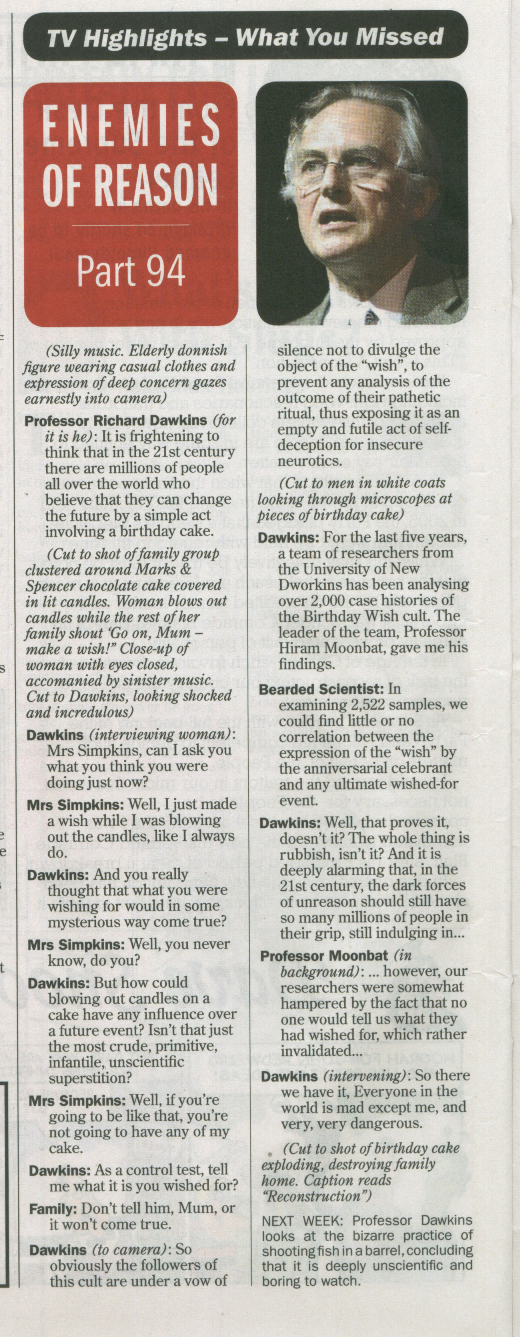 Here is an excellent parody of Richard Dawkins position from a recent "Private Eye" that I thought was fun!!
Thursday, 16 August 2007
Arguments for the existence of God
I have had the opportunity to listen to Bill Craig recently who uses four arguments for the existence of God:
1) The moral argument
2) The argument from design
3) The historicity/authenticity of Jesus and the bible
4) Personal experience of transformation
Argument 1 I do not like because I have yet to hear/see any good evidence for why morality cannot be subject to natural selection.
Argument 2 I like, but is perhaps a bit of a "God of the gaps" argument for me. I do my best to read popular physics books and the articles on quantum mechanics etc in the news and views section of Nature, however to be honest my grasp of the subject is not good enough to form an opinion. I would like to think that phenomena such as quantum entanglement could provide an answer to the problem of life after death etc., however must admit that this is more wistful thinking than anything else. I am happy to trust people like John Polkinghorne on this one.
Argument 3 I am also not convinced by. Just because these so many thousands of manuscripts exist does not mean that the original story itself is more authentic, only that after a certain point (normally quoted as a couple hundred years after Jesus lived) lots of copies were made. To be fair I think we are so far removed from the events in the gospels that we cannot really prove things either way and thus have no choice but to view the bible as a text revealing the traditions, stories and mythology that lies behind our current Christian culture.
Argument 4 I find persuasive. Indeed I spent a couple weeks convinced that I had become an atheist whilst studying for my PhD until I realised the sheer power of the person of Jesus and the implications that following his tradition might have on my life. I am given a lot of stick in my lab for being a Christian, however like to point out that "even" if the central beliefs of Christianity were to be proven as false in the end, the ideal of Jesus, and a life lived by his teachings, would be a life I would want to choose. Thus for me choosing to experience the presence of God in a grand cathedral, by the bed of a sick loved one, or when feeling lost and alone is a persuasive argument indeed. This is how I experience the transcending, transformative power of the gospel of Christ, and is the reason why I am a Christian.
1) The moral argument
2) The argument from design
3) The historicity/authenticity of Jesus and the bible
4) Personal experience of transformation
Argument 1 I do not like because I have yet to hear/see any good evidence for why morality cannot be subject to natural selection.
Argument 2 I like, but is perhaps a bit of a "God of the gaps" argument for me. I do my best to read popular physics books and the articles on quantum mechanics etc in the news and views section of Nature, however to be honest my grasp of the subject is not good enough to form an opinion. I would like to think that phenomena such as quantum entanglement could provide an answer to the problem of life after death etc., however must admit that this is more wistful thinking than anything else. I am happy to trust people like John Polkinghorne on this one.
Argument 3 I am also not convinced by. Just because these so many thousands of manuscripts exist does not mean that the original story itself is more authentic, only that after a certain point (normally quoted as a couple hundred years after Jesus lived) lots of copies were made. To be fair I think we are so far removed from the events in the gospels that we cannot really prove things either way and thus have no choice but to view the bible as a text revealing the traditions, stories and mythology that lies behind our current Christian culture.
Argument 4 I find persuasive. Indeed I spent a couple weeks convinced that I had become an atheist whilst studying for my PhD until I realised the sheer power of the person of Jesus and the implications that following his tradition might have on my life. I am given a lot of stick in my lab for being a Christian, however like to point out that "even" if the central beliefs of Christianity were to be proven as false in the end, the ideal of Jesus, and a life lived by his teachings, would be a life I would want to choose. Thus for me choosing to experience the presence of God in a grand cathedral, by the bed of a sick loved one, or when feeling lost and alone is a persuasive argument indeed. This is how I experience the transcending, transformative power of the gospel of Christ, and is the reason why I am a Christian.
Wednesday, 1 August 2007
Why I don't think Dawkins is too bad...
In an article published in the Times in May entitled "How dare you call me a fundamentalist" Richard Dawkins answers some of the criticism that has come his way since publishing his rather dubious book "The God Delusion". The article can be found here however I was rather struck by the following excerpt:
...and I see his point. For once Dawkins has not actually lumped all believers into the same category and acknowledged that there is a vast difference between the belief of Rowan Williams and Pat Robertson.
Although atheists tend to sound a bit too bitter for the good of their own argument, I think Dawkins has generally been quite useful for religious belief. Much like Dawkins I am horrified by much of what goes on in the name of religion, and want to distance myself as far from some Christians as Dawkins does. In fact in many cases I find myself agreeing far more with Dawkins than I do with some others who call themselves Christians. These people do need to be confronted, and as robustly as possible, or else they risk pulling all religious belief into disrepute. In this respect I find Dawkins saying many of the things that I would really like to say, but that my well-behaved Christian politic just won't let me. I'm not saying that Dawkins isn't a twit - he strikes me as rather bitter and self-obsessed - however sometimes he does make some useful points!
If subtle, nuanced religion predominated, the world would be a better place and I would have written a different book. The melancholy truth is that decent, understated religion is numerically negligible. Most believers echo Robertson, Falwell or Haggard, Osama bin Laden or Ayatollah Khomeini. These are not straw men. The world needs to face them, and my book does so.
...and I see his point. For once Dawkins has not actually lumped all believers into the same category and acknowledged that there is a vast difference between the belief of Rowan Williams and Pat Robertson.
Although atheists tend to sound a bit too bitter for the good of their own argument, I think Dawkins has generally been quite useful for religious belief. Much like Dawkins I am horrified by much of what goes on in the name of religion, and want to distance myself as far from some Christians as Dawkins does. In fact in many cases I find myself agreeing far more with Dawkins than I do with some others who call themselves Christians. These people do need to be confronted, and as robustly as possible, or else they risk pulling all religious belief into disrepute. In this respect I find Dawkins saying many of the things that I would really like to say, but that my well-behaved Christian politic just won't let me. I'm not saying that Dawkins isn't a twit - he strikes me as rather bitter and self-obsessed - however sometimes he does make some useful points!
Wednesday, 25 July 2007
Evolution and Creation
I think when discussing this topic we need to distinguish exactly what is meant by the labels "creationist" and "evolutionist" as I really do not think that these words refer to mutually exclusive concepts.
1) Evolution(ist) is probably the easier of the two to understand, which in this context I take to mean something along the lines of "a theory that explains the origin of complex biological organisms from simpler organisms, through Darwins theory of natural selection acting in a non-teleological fashion upon genes". Perhaps what is important to notice is that this does NOT say anything about God, nor does it explain how the first "life" came about.
2) Creation(ist) has all sorts of loaded meanings, however in its simplest from merely means someone who believes that God created the universe/life/us. Using this definition being a creationist is not incompatible with accepting the mechanism of evolution for creation.
HOWEVER there are also three other defnitions of "Creationist" which are not compatible with evolutionary theory, namely 6-day or Young Earth Creationism (YEC), Old Earth Creationism (OEC) and Intelligent Design Creationism (IDC). What is interesting is that such movements are actually fairly modern reactions TO science rather than some form of religious orthodoxy. Granted prior to Darwin there was no alternative to direct supernatural causation as the mechanism for creation, however despite this need for the supernatural within Christian/European thinking much of the reason for the scientific revolution in Europe was actually due to Christianity teaching that a separating between God and nature (the book of life) was OK. Indeed the response to Darwin amongst theologians was not too different from the response he received from scientists - mixed reaction at first followed by almost complete acceptance within about 50 to 100 years. As such, far from representing some form of orthodoxy, YEC, OEC and IDC actually represent fairly modern UN-orthodox responses by Christians.
This historical background is helpful to see where the disagreement comes from as it has direct relevance to the two areas of contention regarding origins - namely the interpretation of evidence and the understanding of philosophical consequences. My experience is that the latter (the philosophical consequences) actually distort the former (the scientific evidence) so much that it is not actually worth arguing about the scientific evidence. Note I AM NOT saying the scientific evidence is not important, but rather that we need to examine our philosophical baggage before we can stand a chance of fairly understanding the science.
1) Evolution(ist) is probably the easier of the two to understand, which in this context I take to mean something along the lines of "a theory that explains the origin of complex biological organisms from simpler organisms, through Darwins theory of natural selection acting in a non-teleological fashion upon genes". Perhaps what is important to notice is that this does NOT say anything about God, nor does it explain how the first "life" came about.
2) Creation(ist) has all sorts of loaded meanings, however in its simplest from merely means someone who believes that God created the universe/life/us. Using this definition being a creationist is not incompatible with accepting the mechanism of evolution for creation.
HOWEVER there are also three other defnitions of "Creationist" which are not compatible with evolutionary theory, namely 6-day or Young Earth Creationism (YEC), Old Earth Creationism (OEC) and Intelligent Design Creationism (IDC). What is interesting is that such movements are actually fairly modern reactions TO science rather than some form of religious orthodoxy. Granted prior to Darwin there was no alternative to direct supernatural causation as the mechanism for creation, however despite this need for the supernatural within Christian/European thinking much of the reason for the scientific revolution in Europe was actually due to Christianity teaching that a separating between God and nature (the book of life) was OK. Indeed the response to Darwin amongst theologians was not too different from the response he received from scientists - mixed reaction at first followed by almost complete acceptance within about 50 to 100 years. As such, far from representing some form of orthodoxy, YEC, OEC and IDC actually represent fairly modern UN-orthodox responses by Christians.
This historical background is helpful to see where the disagreement comes from as it has direct relevance to the two areas of contention regarding origins - namely the interpretation of evidence and the understanding of philosophical consequences. My experience is that the latter (the philosophical consequences) actually distort the former (the scientific evidence) so much that it is not actually worth arguing about the scientific evidence. Note I AM NOT saying the scientific evidence is not important, but rather that we need to examine our philosophical baggage before we can stand a chance of fairly understanding the science.
Atonement
In the past I have been fairly outspoken against the widely held protestant evangelical doctrine of "penal substitutionary atonement". The following is a conversation I had with a young Evangelical student where I explain why I think the understanding of this doctrine is critical for Christian belief.
Kathryn – April 24th
Hi Simon,
I'm sorry for the very random message from a random person.
I'm interested to hear your views regarding the alternative to penal substitution and how this is Biblically justified. I can only see one Gospel, one Saviour, one cross and only one way of being at peace with God. It concerns me that either myself or others have missed the biggest point the universe could ever miss.
I hope you can answer my question,
Kathryn
Simon - April 24th
Hi Kathryn,
Check out the atonement page on wikipedia for a bit more of a historical perspective and perhaps some of the links (although many of the articles still need a fair amount more effort).
Essentially it boils down to what exactly is meant by the words "saved by the blood of Jesus". It has been argued by some fairly eminent scholars (my favourite is Rene Girard) that the story of the bible is a story AWAY from sacrifice. It starts with Abraham NOT sacrificing Isaac, followed by the Jews substituting animals for people, the realization by the prophets that sacrifice alone does not bring righteousness, and culminates in Jesus being the "final sacrifice". Thus there is a progressive revelation echoing the words of Hosea 6:6 (For I desire mercy, not sacrifice, and acknowledgment of God rather than burnt offerings.) In this view the important aspect is not the sacrifice per se, but rather the revelation by mankind that sacrifice is not necessary for a relationship with God. Indeed the death of Jesus showed once and for all that it is not sacrifice that will redeem man, but rather a pure heart obedient to the will of God. This is a progressive gospel interpretation that emphasizes love rather than empire building and favouritism.
The penal substitution theory is sort of heading in the right direction by coming up with a reason why sacrifice is no longer required, however in my (and many orthodox scholars) opinion PS goes a little bit too far by emphasizing Gods wrath rather than his love. Although I do not think it should be thrown out completely, UCCF has been a little bit naive in not recognizing the sheer amount of parallel scholarship within the area of atonement theories.
Perhaps the best summing up of why Jesus died is provided by the following hymn:
When I survey the wondrous cross
On which the Prince of glory died,
My richest gain I count but loss,
And pour contempt on all my pride.
Forbid it, Lord, that I should boast,
Save in the death of Christ my God!
All the vain things that charm me most,
I sacrifice them to His blood.
See from His head, His hands, His feet,
Sorrow and love flow mingled down!
Did e’er such love and sorrow meet,
Or thorns compose so rich a crown?
Were the whole realm of nature mine,
That were a present far too small;
Love so amazing, so divine,
Demands my soul, my life, my all.
Kathryn - April 24th
Thanks for getting back to me,
I had a look at the wikipedia page and it was very helpful.
I wonder if the prophets were aware that sacrifice didn't bring about righteousness because the sacrificing of animals was not good enough. It was temporary forgiveness and therefore incomplete. If sacrifice is not necessary for a relationship with God then why sacrifice at all? Why does it feature in the Bible and why would Jesus claim to die for our salvation if this were not so? Also, in an absence of sufficient sacrifice, then the gospel is not the gospel. Jesus only did a half job and Christians are still in rebellion against Him. It implies that we can somehow make our own way to God, much like a Muslim or Buddhist.
What do you take from the words 'when I survey the wondrous cross on which the Prince of glory died'? For me, these words from Hebrews sum it up: the blood of goats and bulls and the ashes of a heifer sprinkled on those who are ceremonially unclean sanctify them so that they are outwardly clean. How much more, then, will the blood of Christ, who through the eternal Spirit offered himself unblemished to God, cleanse the consciences from acts that lead to death, so that we may serve the living God!
In regard to God's wrath, what do you think of it? I think God is entirely just to be angry towards sin, the cross is the greatest act of love because of the seriousness of the situation. If God were not angry, then the cross looses its 1) purpose and 2)indication of how great God's love is.
Also, are there any passages regarding the cross which claim that the blood of Christ doesn't redeem man? Surely the pure heart follows the forgiveness, because I for one and no other human being can claim that for themselves.
Kathryn
Simon April 25th
"If sacrifice is not necessary for a relationship with God then why sacrifice at all?"
I think in order to understand this we have to look at the anthropology of religion and try to understand how power manifests itself in and through religion. We are getting onto quite complex ground here which has taken up many books, however for a short introduction I would highly recommend Girard's article found at:
http://www.firstthings.com/article.php3?id_article=3856
This is more NT based (it is titled "Are the gospels mythical?") so I would recommend the book "Violence Unveiled" by the American scholar Gil Bailie for a better exposition.
In brief, religion historically is most often used as a tool to exert power, either over other people or (less efficiently) over nature. Thus when one group of people feel out of control, they evoke the help of their God to get back into control. Evoking supernatural help can take a variety of forms, but most commonly involves some form of ritual. Not surprisingly if supernatural help is needed really badly, the worshiper is prepared to go to great lengths in their ritual, culminating with human sacrifice. This theme is seen over and over in pretty much every culture in the world.
Christianity, however, is different. The story of Abraham sacrificing Isaac to God is powerful not because Abraham was prepared to sacrifice Isaac (sacrificing children to gods was quite common at the time) instead the revelation for Abraham was that an animal was "just as good". Following on from this Moses proposes a law based entirely on merit (the first ten commandments) however since the Israelites were not in the position to adopt a system completely absent from ritual, Moses then codifies a law using ritual sacrifice in order to back up the moral law of the ten commandments. Fast forward to the prophets and we find the effectiveness of the sacrificial law breaking down, and hence the revelation of the greatest prophet (son of God) Jesus - read Hebrews 10.
The important thing to remember is the travesty of spilling Jesus' blood. Jesus was completely innocent, and yet he was killed by humans involved in power struggles. But the shock of his death, the real power of the cross, was in exposing mankind sinfulness. When we look at Jesus, when we see his blood spilt, we cannot help but see how we brought about his innocent death in order to satisfy our own sins. The power of the cross is twofold - the exposure of our sinful nature AND the love of a God who was willing to sacrifice himself for our sins.
Kathryn - April 25th
So just to clarify, do you believe that you are a sinner and forgiven only through Jesus? If not, then how?
Simon - April 25th
Yes I do believe I am a sinner and in need of forgiveness. Jesus shows me my sins and then forgives me. He also shows me that I am forgiven by grace, not by trying to curry favour with God through works (or sacrifices!).
If anything you are probably right in accusing me of holding too high an estimation of God's love, grace and purpose. The only thing I deny is that God is wrathful towards the creation he designed. Sacrifice is in the bible for the purpose of subverting man's power-lust, not providing some form of cosmic magic.
Incidentally Bishop tom Wright has just published an essay commenting on the recent going ons from a theological perspective:
http://www.fulcrum-anglican.org.uk/news/2007/20070423wright.cfm?doc=205
Kathryn - April 25th
I totally agree that forgiveness is all through God's grace. But I am still confused as to why you need forgiveness if God isn't wrathful. No wrath = no need for forgiveness and God wouldn't be a loving God if he didn't stand against the evil that is sin. Our little brains aren't big enough to understand what an offence sin is to him, therefore we cant really understand his full anger towards it, but by having some appreciation of it we can then begin to grasp what an absolute act of love and forgiveness his sacrifice was.
I would argue that someone who acknowledges God's wrath therefore acknowledges him as a God of greater love and grace than someone who didn't.
Simon - April 26th
I think it is important here to draw a distinction between evil and sin:
1) Evil is something that happens outside of God's perfect purpose. Thus by definition God is opposed to (hates?) all things that are evil. However it is important to realise that evil is a CONSEQUENCE of some human activity, and thus no person is evil.
2) Sin is the human activity that produces evil. A sin is thus a bad choice that gives a result contrary to God's will. God made us with the capacity to sin simply because sin is a necessary part of free-will. The important thing to realise is that sin is a potential, not a metaphysical position.
Hopefully you will see the consequences of these definitions. If a man sins, they produce evil. God hates the evil and is sad that the person sinned. However this has nothing to do with wrath against the man who sinned. God made us with the capacity to sin, and thus it would be crazy if he blamed us for having something he gave us. The revelation of Jesus is one of forgiveness for our sins coupled with strength to help us sin no more. This is indeed the good news of the gospel - God knows us, loves us, and wants to help us "sin no more".
What I believe
The other day someone asked me why I considered myself a Christian and what "my" God was like:
I always liked the quote "God made man in his own image and then man returned the favour!"
My God is:
Omnipotent
Omniscient
Has a personality/character
Was incarnate in Jesus
Communicates with us through the Holy Spirit (although what counts as communication is up to the individual)
Thus I can say I am a Christian because:
I believe in one God the Father Almighty,
Maker of heaven and earth,
And of all things visible and invisible:
And in one Lord Jesus Christ, the only-begotten Son of God,
Begotten of his Father before all worlds,
God of God, Light of Light,
Very God of very God,
Begotten, not made,
Being of one substance with the Father,
By whom all things were made;
Who for us men, and for our salvation came down from heaven,
And was incarnate by the Holy Ghost of the Virgin Mary,
And was made man,
And was crucified also for us under Pontius Pilate.
He suffered and was buried,
And the third day he rose again according to the Scriptures,
And ascended into heaven,
And sitteth on the right hand of the Father.
And he shall come again with glory to judge both the quick and the dead:
Whose kingdom shall have no end.
And I believe in the Holy Ghost,
The Lord and giver of life,
Who proceedeth from the Father and the Son,
Who with the Father and the Son together is worshipped and glorified,
Who spake by the Prophets.
And I believe one Catholick and Apostolick Church.
I acknowledge one Baptism for the remission of sins.
And I look for the Resurrection of the dead,
And the life of the world to come.
Amen.
I have to admit at one stage I had a problem with the whole virgin birth and resurrection thing, but then decided I liked the aesthetic nature of this element of the Christian faith so decided to adopt it (additionally as my problem with miracles is the negative implications (ie why did one person get healed and not another) Jesus seemed the one miracle without negative implications because he came "for all men"). Secondly, regarding heaven, sin and judgment, I think this can be interpreted quite widely and thus is not solely dependent upon traditional "clouds vs firey pit" understandings. Thirdly, to my mind "baptism for the remission of sins" means an acknowledgment sealed by ritual regarding personal responsibility".
Mind you I do think the main reason why I am a Christian is not because I think I can square it intellectually, but rather because I find personal value in the belief system on an everyday basis.
I always liked the quote "God made man in his own image and then man returned the favour!"
My God is:
Omnipotent
Omniscient
Has a personality/character
Was incarnate in Jesus
Communicates with us through the Holy Spirit (although what counts as communication is up to the individual)
Thus I can say I am a Christian because:
I believe in one God the Father Almighty,
Maker of heaven and earth,
And of all things visible and invisible:
And in one Lord Jesus Christ, the only-begotten Son of God,
Begotten of his Father before all worlds,
God of God, Light of Light,
Very God of very God,
Begotten, not made,
Being of one substance with the Father,
By whom all things were made;
Who for us men, and for our salvation came down from heaven,
And was incarnate by the Holy Ghost of the Virgin Mary,
And was made man,
And was crucified also for us under Pontius Pilate.
He suffered and was buried,
And the third day he rose again according to the Scriptures,
And ascended into heaven,
And sitteth on the right hand of the Father.
And he shall come again with glory to judge both the quick and the dead:
Whose kingdom shall have no end.
And I believe in the Holy Ghost,
The Lord and giver of life,
Who proceedeth from the Father and the Son,
Who with the Father and the Son together is worshipped and glorified,
Who spake by the Prophets.
And I believe one Catholick and Apostolick Church.
I acknowledge one Baptism for the remission of sins.
And I look for the Resurrection of the dead,
And the life of the world to come.
Amen.
I have to admit at one stage I had a problem with the whole virgin birth and resurrection thing, but then decided I liked the aesthetic nature of this element of the Christian faith so decided to adopt it (additionally as my problem with miracles is the negative implications (ie why did one person get healed and not another) Jesus seemed the one miracle without negative implications because he came "for all men"). Secondly, regarding heaven, sin and judgment, I think this can be interpreted quite widely and thus is not solely dependent upon traditional "clouds vs firey pit" understandings. Thirdly, to my mind "baptism for the remission of sins" means an acknowledgment sealed by ritual regarding personal responsibility".
Mind you I do think the main reason why I am a Christian is not because I think I can square it intellectually, but rather because I find personal value in the belief system on an everyday basis.
Friday, 20 July 2007
The beginning
Science and faith are always in conflict. On one side there are the fundamental religious believers who are keen to warp and distort both science and scripture so that they fit their narrow interpretations of the world. On the other side there are the fundamental atheists whose cynicism and confrontational style suggests a chip on their shoulder and an intellectual stubborness. When the two meet there are flames that destroy all and sundry.
Between the two we have more moderate believers, people like myself who have been trained in science (I hold a PhD in Biochemistry) but are also believers in God (I am a member of the Anglican church). I consider myself a person of faith, despite the objections of some fundamental Christians I have come across. I also consider myself someone who examines evidence fairly, despite the objections of some fundamental atheists I have come across.
This is a blog where I can air my frustrations and thoughts.
Between the two we have more moderate believers, people like myself who have been trained in science (I hold a PhD in Biochemistry) but are also believers in God (I am a member of the Anglican church). I consider myself a person of faith, despite the objections of some fundamental Christians I have come across. I also consider myself someone who examines evidence fairly, despite the objections of some fundamental atheists I have come across.
This is a blog where I can air my frustrations and thoughts.
Subscribe to:
Posts (Atom)