Wednesday, 20 August 2008
The Genius of Charles Darwin Episode 3...
I think the most notable part of this episode is how reasonable and nuanced Rowan William sounds. Richard may not like the idea of having cake AND eating it, however there is an alternative to both religious and atheist fundamentalism.


Saturday, 16 August 2008
The genius of Charles Darwin - Episode 2
Episode 2 hasn't been posted online by channel four, nor could I find it in an easily linkable form as for part one (below), however you can watch it on youtube so long as you don't mind it being split into five parts and hosted by a user called "CrucieFiction":
He starts off rather poorly with his usual anti-religious tourettes problem including an interview with a completely clueless African bishop, however thankfully he soon moves on to what he is good at, explaining evolutionary biology for the lay person. As usual I cannot fault him when he has his zoologists/educators hat on. I just wish he didn't accompany it with so much other ignorant rhetoric!
He starts off rather poorly with his usual anti-religious tourettes problem including an interview with a completely clueless African bishop, however thankfully he soon moves on to what he is good at, explaining evolutionary biology for the lay person. As usual I cannot fault him when he has his zoologists/educators hat on. I just wish he didn't accompany it with so much other ignorant rhetoric!
Wednesday, 13 August 2008
Evangelical Triumphalism
I am right on the border of being an Evangelical. For many years I was an Evangelical however there are certain things within the tradition that I really do not like. Currently the thing that is annoying me most is the triumphalist ring to supposedly "academic" or at least scholarly Evangelical literature.
To me, a good academic treatment of a subject tries it's best to stand back a bit from it's subject. In other words when I read a paper or book I expect the author to at least try not to sound too prejudiced. This rule, however, is not adhered to within much Evangelical literature. Time and again I read supposedly scholarly accounts that implicitly assume there is a "right" interpretation and thus assess the history or philosophy in comparison to this assumed "correct" account. The result is a book that sounds extremely arrogant and somewhat blinkered, and more importantly misses the value of looking to see how philosophy or history might actually question certain aspects of the Evangelical creed. Two examples that I have read recently are Earle Cairn's "Christianity through the ages" which is particularly bad and John Stotts "The Cross of Christ".
My suspicion is that this observation is consistent with a more insidious, authoritarian side of the Evangelical movement. There seems to be (a sometimes openly stated) assumption that if someone is in a position of authority - either as a leader or author - then God has placed them there and thus they have God-given authority. Although there is room for a level of criticism, negative comments are quickly labeled as "judgmental" or "un-gracious", thus exerting psychological pressure on the questioner to stop their criticism. The result is a status-quo represented as a series of beliefs to which no questions can be asked, and any evidence against the wisdom of the belief being ignored or swept under the carpet. Such a situation cannot be good in the pursuit of God.
Thursday, 7 August 2008
The Genius of Charles Darwin - Richard Dawkins episode 1
Watched the above episode of Richard Dawkins new documentary last night - I was not impressed.
Although I agree entirely with Dawkins that Darwin was a genius, and that evolution is one of the most ground breaking and powerful explanatory theories within science, I simply cannot abide his anti-religion rhetoric. Is he not aware of any of the scholarship regarding the interplay between science and faith? Has he not paid any attention to his numerous discussions with people like Alistair McGrath?
Yet again Dawkins produces a polemical program that does nothing to further the debate. I imagine all the internet atheists will be jumping up and down waving their flags whilst the YECS re-double their anti-science efforts. Meanwhile those of us who are actually interested in the subject can do nothing but shake our heads and gear ourselves up for the inevitable pub conversation about how evolution has "disproved" religion... sigh.
Saturday, 2 August 2008
3rd Way
I have recently been quite interested by the discussion emanating from Denis Alexander's excellent article entitled "Viva la evolution" on the third way website.
After a group of YECS decided to reply on mass CiS mobilised and responded on mass. It seems that a lot of different groups are gearing themselves up for next years 200th anniversary of Darwin's birth.
Along with the usual polemics surrounding this subject I was quite interested to note quite how loosely the term"Darwinism" was being used by everyone. Some (mostly YECS) equated it with materialism or naturalism, whilst those from a more scientific background equated it with evolution in general. Everyone seemed to overlook the technical usage of the word which equates to Darwin's specific beliefs which, along with evolution through decent, modification and natural selection, also contained ideas such as panspermia. Of course the phrase neo-Darwinism was then coined to refer to Mendelian genetics merged with natural selection, however even that is somewhat out of date, especially as recent results from the fields of epigenetics and RNAi seem to indicate some really quite interesting alternatives to simple gene based evolution.
This looseness of terminology unfortunately leads to confusion, and thus plays into the YECS hands. All of a sudden the normal (and exciting) development of evolutionary science is seen as undermining "Darwinism" (which of course it does) and thus somehow backing up the creationist arguments. I think it is time to put to bed the idea that Darwinism equates to evolution. Evolutionary theory is strong and developing. Darwin made a seminal contribution with his idea of natural selection, but science has now moved on rapidly. It is time people began to view Darwinism in the same way they view Newtonianism.
After a group of YECS decided to reply on mass CiS mobilised and responded on mass. It seems that a lot of different groups are gearing themselves up for next years 200th anniversary of Darwin's birth.
Along with the usual polemics surrounding this subject I was quite interested to note quite how loosely the term"Darwinism" was being used by everyone. Some (mostly YECS) equated it with materialism or naturalism, whilst those from a more scientific background equated it with evolution in general. Everyone seemed to overlook the technical usage of the word which equates to Darwin's specific beliefs which, along with evolution through decent, modification and natural selection, also contained ideas such as panspermia. Of course the phrase neo-Darwinism was then coined to refer to Mendelian genetics merged with natural selection, however even that is somewhat out of date, especially as recent results from the fields of epigenetics and RNAi seem to indicate some really quite interesting alternatives to simple gene based evolution.
This looseness of terminology unfortunately leads to confusion, and thus plays into the YECS hands. All of a sudden the normal (and exciting) development of evolutionary science is seen as undermining "Darwinism" (which of course it does) and thus somehow backing up the creationist arguments. I think it is time to put to bed the idea that Darwinism equates to evolution. Evolutionary theory is strong and developing. Darwin made a seminal contribution with his idea of natural selection, but science has now moved on rapidly. It is time people began to view Darwinism in the same way they view Newtonianism.
Monday, 28 July 2008
Occasional blogger...
I've decided I am not particularly good with the old blogging thing. I remembered my blog after rather a while today and decided I had to post something just so that it didn't look as if I have died!
Actually I am not sure if I like blogs because they do not seem to have too much interaction with other people. About the only useful thing is being able to post slightly longer essays so that if (on the occasion!) I happen to be discussing something with someone on a forum I can point them to a more thought through version of my thoughts. Thus said I have just started a new blog that I aim to use for recording work projects - checkout http://dockingtoolbox.blogspot.com/
Actually I am not sure if I like blogs because they do not seem to have too much interaction with other people. About the only useful thing is being able to post slightly longer essays so that if (on the occasion!) I happen to be discussing something with someone on a forum I can point them to a more thought through version of my thoughts. Thus said I have just started a new blog that I aim to use for recording work projects - checkout http://dockingtoolbox.blogspot.com/
Monday, 17 September 2007
Dawkins and Collins on the Colbert Report
Both Francis Collins, head of the genome project and author of "The Language of God - a scientist presents evidence for belief" and Richard Dawkins (who has been quite critical of Collins) have featured on the satirical American program "The Colbert Report". Stephen Colbert adopts the persona of an extremely conservative, Christian interviewer with rather amusing results. I'll let others judge which of the two has the better sense of humour!
You can see Collins' interview on the Comedy Central website once you've got past the adverts, and the Dawkins interview from RichardDawkins.net:
Collins on the Colbert Report
Dawkins on the Colbert Report
You can see Collins' interview on the Comedy Central website once you've got past the adverts, and the Dawkins interview from RichardDawkins.net:
Collins on the Colbert Report
Dawkins on the Colbert Report
Dawkins and cake
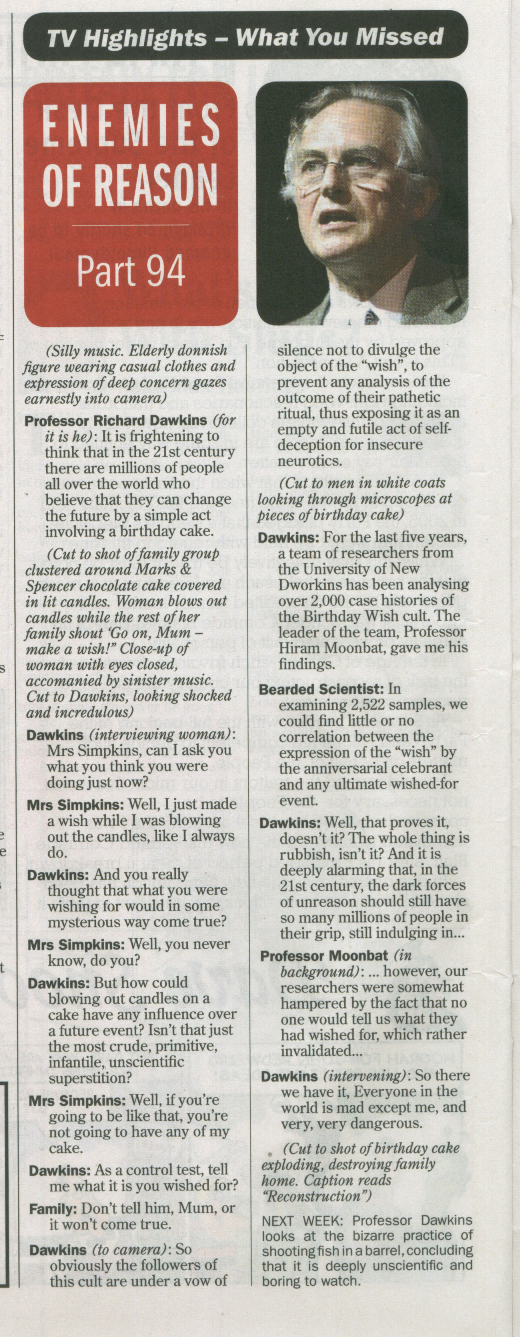 Here is an excellent parody of Richard Dawkins position from a recent "Private Eye" that I thought was fun!!
Thursday, 16 August 2007
Arguments for the existence of God
I have had the opportunity to listen to Bill Craig recently who uses four arguments for the existence of God:
1) The moral argument
2) The argument from design
3) The historicity/authenticity of Jesus and the bible
4) Personal experience of transformation
Argument 1 I do not like because I have yet to hear/see any good evidence for why morality cannot be subject to natural selection.
Argument 2 I like, but is perhaps a bit of a "God of the gaps" argument for me. I do my best to read popular physics books and the articles on quantum mechanics etc in the news and views section of Nature, however to be honest my grasp of the subject is not good enough to form an opinion. I would like to think that phenomena such as quantum entanglement could provide an answer to the problem of life after death etc., however must admit that this is more wistful thinking than anything else. I am happy to trust people like John Polkinghorne on this one.
Argument 3 I am also not convinced by. Just because these so many thousands of manuscripts exist does not mean that the original story itself is more authentic, only that after a certain point (normally quoted as a couple hundred years after Jesus lived) lots of copies were made. To be fair I think we are so far removed from the events in the gospels that we cannot really prove things either way and thus have no choice but to view the bible as a text revealing the traditions, stories and mythology that lies behind our current Christian culture.
Argument 4 I find persuasive. Indeed I spent a couple weeks convinced that I had become an atheist whilst studying for my PhD until I realised the sheer power of the person of Jesus and the implications that following his tradition might have on my life. I am given a lot of stick in my lab for being a Christian, however like to point out that "even" if the central beliefs of Christianity were to be proven as false in the end, the ideal of Jesus, and a life lived by his teachings, would be a life I would want to choose. Thus for me choosing to experience the presence of God in a grand cathedral, by the bed of a sick loved one, or when feeling lost and alone is a persuasive argument indeed. This is how I experience the transcending, transformative power of the gospel of Christ, and is the reason why I am a Christian.
1) The moral argument
2) The argument from design
3) The historicity/authenticity of Jesus and the bible
4) Personal experience of transformation
Argument 1 I do not like because I have yet to hear/see any good evidence for why morality cannot be subject to natural selection.
Argument 2 I like, but is perhaps a bit of a "God of the gaps" argument for me. I do my best to read popular physics books and the articles on quantum mechanics etc in the news and views section of Nature, however to be honest my grasp of the subject is not good enough to form an opinion. I would like to think that phenomena such as quantum entanglement could provide an answer to the problem of life after death etc., however must admit that this is more wistful thinking than anything else. I am happy to trust people like John Polkinghorne on this one.
Argument 3 I am also not convinced by. Just because these so many thousands of manuscripts exist does not mean that the original story itself is more authentic, only that after a certain point (normally quoted as a couple hundred years after Jesus lived) lots of copies were made. To be fair I think we are so far removed from the events in the gospels that we cannot really prove things either way and thus have no choice but to view the bible as a text revealing the traditions, stories and mythology that lies behind our current Christian culture.
Argument 4 I find persuasive. Indeed I spent a couple weeks convinced that I had become an atheist whilst studying for my PhD until I realised the sheer power of the person of Jesus and the implications that following his tradition might have on my life. I am given a lot of stick in my lab for being a Christian, however like to point out that "even" if the central beliefs of Christianity were to be proven as false in the end, the ideal of Jesus, and a life lived by his teachings, would be a life I would want to choose. Thus for me choosing to experience the presence of God in a grand cathedral, by the bed of a sick loved one, or when feeling lost and alone is a persuasive argument indeed. This is how I experience the transcending, transformative power of the gospel of Christ, and is the reason why I am a Christian.
Wednesday, 1 August 2007
Why I don't think Dawkins is too bad...
In an article published in the Times in May entitled "How dare you call me a fundamentalist" Richard Dawkins answers some of the criticism that has come his way since publishing his rather dubious book "The God Delusion". The article can be found here however I was rather struck by the following excerpt:
...and I see his point. For once Dawkins has not actually lumped all believers into the same category and acknowledged that there is a vast difference between the belief of Rowan Williams and Pat Robertson.
Although atheists tend to sound a bit too bitter for the good of their own argument, I think Dawkins has generally been quite useful for religious belief. Much like Dawkins I am horrified by much of what goes on in the name of religion, and want to distance myself as far from some Christians as Dawkins does. In fact in many cases I find myself agreeing far more with Dawkins than I do with some others who call themselves Christians. These people do need to be confronted, and as robustly as possible, or else they risk pulling all religious belief into disrepute. In this respect I find Dawkins saying many of the things that I would really like to say, but that my well-behaved Christian politic just won't let me. I'm not saying that Dawkins isn't a twit - he strikes me as rather bitter and self-obsessed - however sometimes he does make some useful points!
If subtle, nuanced religion predominated, the world would be a better place and I would have written a different book. The melancholy truth is that decent, understated religion is numerically negligible. Most believers echo Robertson, Falwell or Haggard, Osama bin Laden or Ayatollah Khomeini. These are not straw men. The world needs to face them, and my book does so.
...and I see his point. For once Dawkins has not actually lumped all believers into the same category and acknowledged that there is a vast difference between the belief of Rowan Williams and Pat Robertson.
Although atheists tend to sound a bit too bitter for the good of their own argument, I think Dawkins has generally been quite useful for religious belief. Much like Dawkins I am horrified by much of what goes on in the name of religion, and want to distance myself as far from some Christians as Dawkins does. In fact in many cases I find myself agreeing far more with Dawkins than I do with some others who call themselves Christians. These people do need to be confronted, and as robustly as possible, or else they risk pulling all religious belief into disrepute. In this respect I find Dawkins saying many of the things that I would really like to say, but that my well-behaved Christian politic just won't let me. I'm not saying that Dawkins isn't a twit - he strikes me as rather bitter and self-obsessed - however sometimes he does make some useful points!
Subscribe to:
Posts (Atom)